Summary
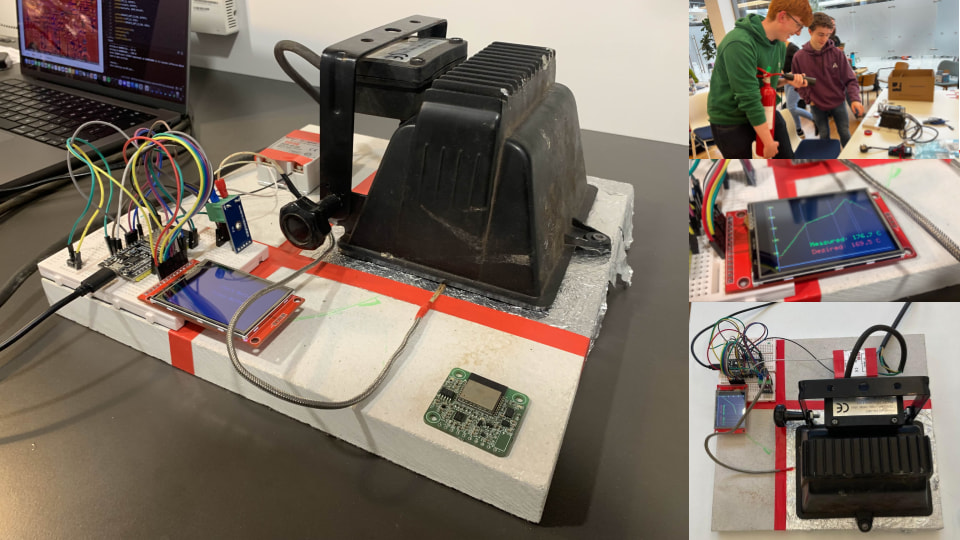
This is the oven I made during the Patch Summer Accelerator in 2024. It began as a way to reflow the ForceField PCBs, then reflowed the first Pace board and was later adapted to anneal twisted-coiled polymer actuators.
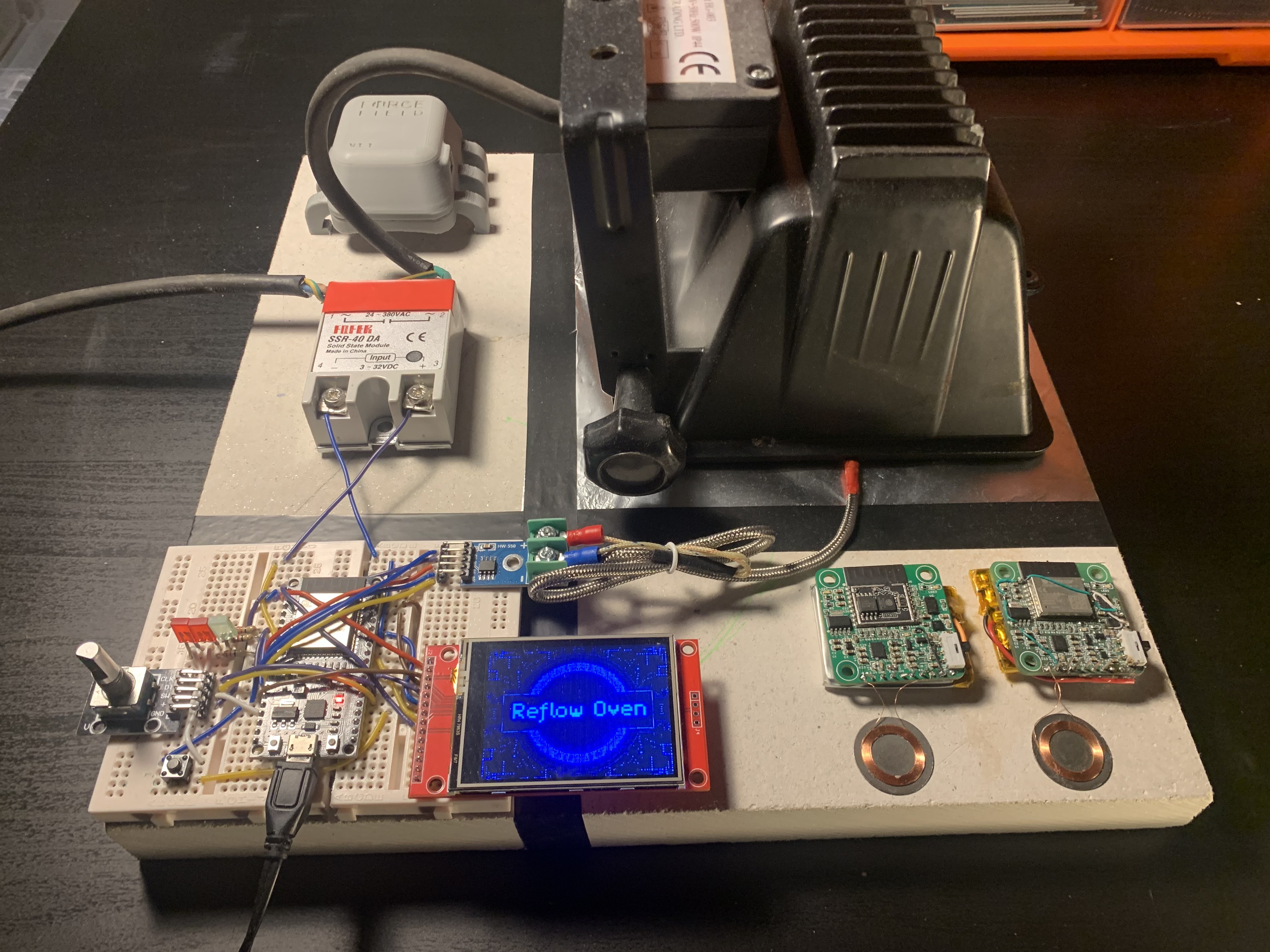
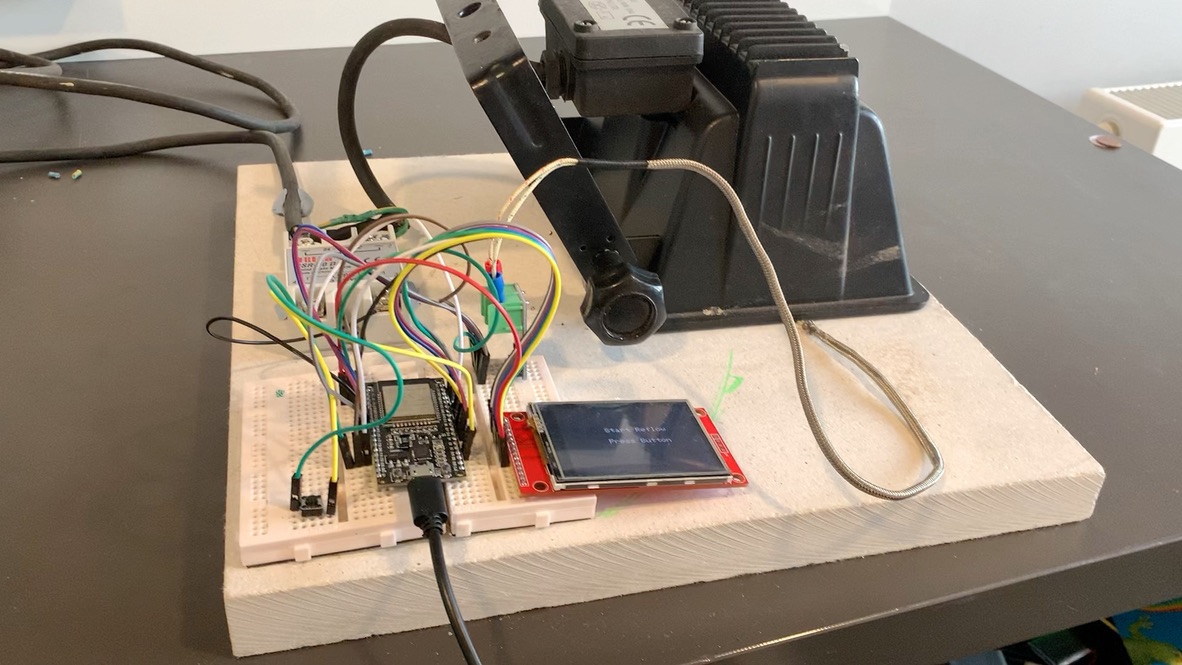
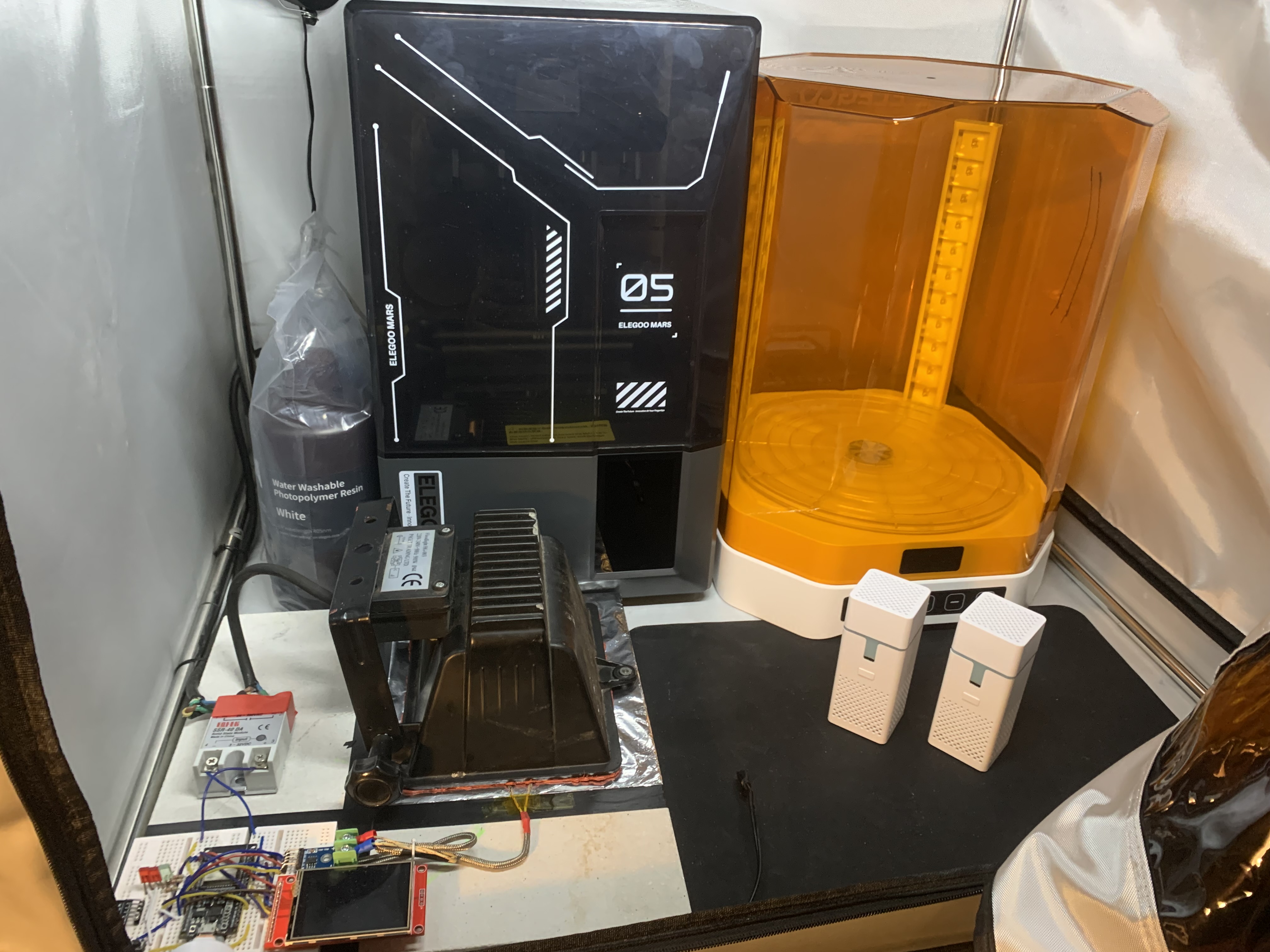
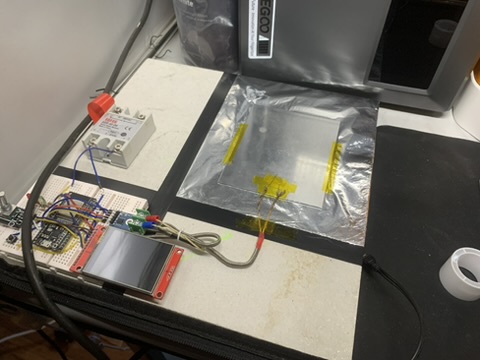
An ESP32 reads a K-type thermocouple through a MAX6675 and time-proportions the floodlamp through a solid-state relay using QuickPID. A rotary encoder and ILI9341 screen select the process and plot requested and measured temperature. The hot surface is still roughly 300 × 300 mm of PROMATECT-H, aluminium and tape.
Justification
My group wanted to hand-assemble the ForceField boards because of the time constraints, and we did not want to wait for a hotplate. My grandfather had a halogen floodlamp and my uncle gave me a roughly 30 × 30 cm sheet of PROMATECT-H insulating board, so that's what I used.
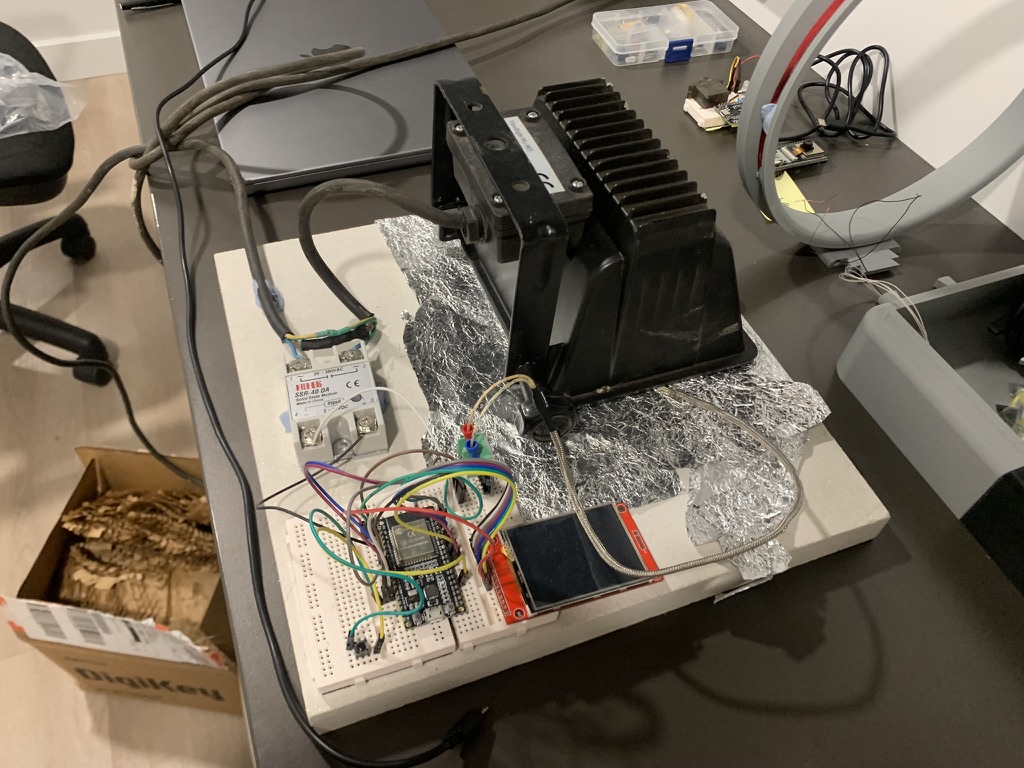
I removed the lamp's glass front and laid it flat on the board. The first arrangement did not ramp adequately. I laid aluminium foil over it and the temperature immediately started climbing properly.
Parts List
- ESP32 DOIT DevKit V1 (ESP32-WROOM)
- K-type thermocouple
- MAX6675 thermocouple interface
- ILI9341 TFT LCD
- Three-pin rotary encoder
- Solid-state relay
- Breadboard
- Halogen floodlamp
- Approximately 300 × 300 mm PROMATECT-H board
- Aluminium foil / aluminium sheet
- Black electrical tape
- RTV silicone sealant
Documentation
Repo: reflowOven.
Build Log
July 2024 - first reflow
I built the first version during Patch from the floodlamp, PROMATECT-H, foil and a breadboard controller. It was not a sealed or particularly elegant oven, but after the foil fixed the ramp it reflowed the ForceField boards within the six-week programme.
October 2024 - cleanup and firmware
I added state-indication LEDs so I could see where the oven was in the reflow cycle, then replaced the tangle of jumper wires with clean solid-core wiring. The breadboard stayed, because it wasn't finished yet.
November 2025 - reflow and annealing firmware
The repository starts late. Its first commit, on 10 November 2025, already calls the firmware v2.3.2 and contains separate Reflow Board and Anneal Twist modes. There is no earlier diff showing the moment I added annealing.
Reflow used a 330-second profile: 25 to 155°C over 135 seconds, a 60-second soak, 70 seconds up to 228°C, a 15-second peak, then 50 seconds down to 160°C. The settings screen exposed the preheat and peak temperatures and times. Annealing ramped from the measured starting temperature to 150°C over 60 seconds and ran for 20 minutes. Both modes plotted target and measured temperature while the controller read the thermocouple every 175 ms and drove the relay in a five-second window.
This version reflowed the first Pace board. The annealing mode turned the same improvised hardware into the tool I used to heat-treat twisted-coiled polymer actuators.
January 2026 - repeated use and fumes
Repeated use surfaced a problem with the original floodlamp: long, hot runs began producing a strong smell. I suspected the painted housing, but never isolated it from the tape, wiring insulation and other materials being heated. I put it in the same ventilated enclosure as my resin-printing setup and built a dedicated fume-extraction system.
January 2026 - general heater and new surface
On 7 January I moved the firmware into PlatformIO and made the annealing path less specific. Anneal Twist became Anneal / Heater: the encoder now selects a target from 20 to 250°C before starting, the default run became one hour, and the settings allow up to ten hours. It retained the 60-second ramp and live target-versus-actual graph. The reflow path stayed alongside it.
I used the general heater mode inside my resin-printing enclosure too. Selecting a low target gave the enclosure some background heat, instead of the floodlamp being limited to full reflow and annealing cycles.
I also refurbished the thermal surface. I laid a new aluminium sheet over the PROMATECT-H, secured it with new black electrical tape and sealed around the rim with RTV silicone. It was maintenance, not a clean rebuild.